Sunday, April 12, 2015

Social media in government: 6 to 12 April 2015

Summary

In the UK, immigration has attracted a lot of buzz in light of the upcoming elections. The Scots are warning Edinburgh against break-ins, and the French TV5Monde was hacked by ISIS. The Russians were also hacked by their own Anonymous International but still found the time to make memes illegal. Turks made YouTube and Twitter illegal, then they legalised them again, while a Bahrain human rights activist live-streamed his arrest. Google is angry with an Egyptian digital certificate organisation while the Dubai Police force got an award for its social media use. The Lebanese have fallen victim to a scam American Ambassador, and Malaysians are arresting defiant cartoonists. The Chinese are looking for 10 million positive youth volunteers despite police in Hunan and Inner Mongolia arresting 60-year-old uncles and environmentalists. The Canadians are concerned with privacy and how bureaucrats and the police use Twitter and Facebook. Americans are angry at the police for another reason and Clinton announces her Presidential bid via social media. Mexican netizens are mad - again - at corrupt politicians as are middle class Salvadorians and Brazilians in general.

Don't forget you can also catch this column on The Brussels Chronicle.


Europe


The United Kingdom


Immigration is the third biggest issue in the upcoming UK elections. The Joint Council for the Welfare of Immigrants (JCWI) has begun the #IAmAnImmigrant campaign to publicise the positive aspects of immigration. The campaign features the faces and personal stories of immigrants to the country. Stories and images can be found online and offline.
Sources: @JCWInews

In Scotland, the police have launched a public service campaign to educate citizens about home break-ins. Home break-ins have been occurring more frequently in Edinburgh, so the police have used legos to construct common ways that burglars can enter the house and posted photos of each lego scene to social media. The campaign is called Operation RAC (#OpRAC).
Sources:  @mashsocialmedia@blathnaidhealy

France


Last Wednesday all 11 channels as well as the Facebook and Twitter accounts of TV5 Monde were hacked by a group that claimed allegiance to ISIS. The group commandeered the Facebook account to allegedly post the personal images and photos of the relatives of French citizens involved in anti-ISIS activities. “Soldiers of France, stay away from the Islamic State! You have the chance to save your families, take advantage of it,” read one message on the Facebook page. “The CyberCaliphate continues its cyberjihad against the enemies of Islamic State.” Comments also referred to the Charlie Hebdo attack in January and threatened the French President. French Prime Minister Manuel Valls tweeted:
Sources:  @manuelvalls


Russia


Anonymous International (also known on Twitter as Shaltay Boltay or @b0ltai2 and @b0ltai) leaked 40 thousand text messages belonging to influential Kremlin official Timur Prokopenko. Shaltay Boltay has released a number of private documents since first publishing Putin's New year's national address hours before the speech was broadcast in 2013. While these text messages have been met with a muted reaction from the Kremlin, some journalists with whom Prokopenko texted have moved to explain their communications with the official. RBC  (Russian media) general director Nikolay Molibog posted his explanation to Facebook. In his Facebook post, Molibog confirmed the texts were real and apologised for any inappropriate communications while defending his association with Prokopenko.

Sources:  


A new poll by the independent Levada Center has demonstrated that Russians overall approve of the Russian leader in Chechnya, a fervent social media user and alleged human rights violator, Ramzan Kadyrov. Kadyrov is on Instagram, Twitter, Facebook, the Russian VKontakte (the Russian Facebook), and LiveJournal. One of his bodyguards is rumoured to be the man behind the murder of Russian opposition leader Boris Nemtsov (allegedly caught on security camera, according to Russian social media. However, nothing has been verified.) Kadyrov is appreciated, according to the poll, because he keeps Chechnya stable - and it can't hurt that he does well popularising his image amongst his social networks.

Дорогие друзья! Сегодня мальчики решили сделать Лечи Курбанову большой подарок на день рождения. По их просьбе мы организовали в честь именинника турнир. Ахмад, Эли и Адам показали всё, чему их научили настоящие мастера. Состоялось несколько поединков. Строгая судейская бригада отметила возросшее мастерство ребят и их выносливость. По единогласному решению победителями стали все трое, а также их настоящее братство и, конечно, дружба с тренером! Мальчики после боев преподнесли Лечи памятный сувенир. #Кадыров #Россия #Чечня #Лечи #Ахмад #Эли #Адам
A video posted by Аллах Велик!!! (@kadyrov_95) on
Sources: @mashsocialmedia


Russia's media watchdog Roskomnadzor has outlawed celebrity memes. Roskomnadzor posted the legal clarification in a VKontakte post last week. The rule follows a lawsuit led by Russian singer Valeri Syutkin, who was the subject of a meme so popular that his last name became synonymous with domestic violence. (The meme juxtaposed the face of the singer, a well-known "lady's man," with an expression from a song about "smacking a bitch.") The law now clarifies that "use of photos of public personas for the purposes of internet memes not pertaining to the actual celebrity" is illegal.
Sources: @mashsocialmedia@moneyries


Middle East


Egypt


Google will no longer trust digital certificates issued by Mideast Communication Systems (MCS), an intermediate certificate authority vetted by China Internet Network Information Center (CNNIC). MCS has been issuing fake digital certificates. This means that it's possible the Egyptian Government, among others, has access to the private log-ins and personal communications of individuals on various social networks (email, Facebook, WhatsApp, etc.). Google will implement their exclusion in future updates of their browser Chrome.

Sources: Google Security blog@middleeastmnt

Turkey


Last week in Turkey, Twitter and YouTube (along with about 100 websites) were banned Monday and then accessible again nationwide by the end of Tuesday. Why? As mentioned in this blog on April 6th, terrorists from the far-left Revolutionary People's Liberation Party-Front (DHKP-C) took Istanbul prosecutor Mehmet Selim Kiraz hostage. Kiraz had been overseeing a controversial case linked to the Gezi protests of May 2013. The prosecutor died during the rescue mission, and photos of the prosecutor while being held hostage as well as of his body post-rescue mission were published on a number of traditional and social media sites. As a result, the Turkish Government withheld the accreditation of several media organizations and journalists who then could not attend the April 1st funeral of Kiraz. Four Turkish newspapers faced criminal investigations due to their publication of the photos. Even Google received a warning from Istanbul's 1st Criminal Court of Peace. While the legality of these bans is under question in some quarters, a presidential spokesman insisted that, “[w]hat happened after the prosecutor’s killing is as grim as the incident itself. Those photos weren’t used by foreign media agencies. The demand from the prosecutor’s office is that these images not be used in any platforms. This is an obligation derived from a necessity. There would be no ban if those photos weren’t shared over and over again. This isn’t about restricting freedoms..” Turks used VPNs and applications like AnchorFree's HotSpot Shield to securely bypass the ban while Turks and others promoted the hashtag #TwitterisblockedinTurkey online.


Sources: @MenekseTK, The Global Voices Netizen Report


A draft document from the National Security Council (NSC) that was leaked to media lists potential threats to Turkey. The document highlights social media along with terror groups including ISIS and the Kurdistan Workers' Party (PKK) as among these threats. Turkey's NSC includes the president, the Turkish government and the commanders of the Turkish Armed Forces. (Just a reminder, as noted earlier in this blog, Canada also listed social media as a threat to national security in a document obtained by the British Columbia Civil Liberties Association.)

Sources: @Yenisafak, @NewsweekEurope


Turkish elections will be held the 7th of June, and social media is shaping up to be a key source of relevant (mis?)information.

Lebanon


Internet scammers attempted to con Lebanese out of money by pretending to be the US Ambassador David Hale on social media. Scammers promised some Lebanese a United Nations job in exchange for money. The US Embassy in Lebanon posted a statement entitled, "The Ambassador Does Not Want Your Money" and invited Lebanese to connect with the real Ambassador Hale, who noted that the US Ambassador has no control over United Nations job appointments. 


Sources: @DailyStarLeb, @BazziNYU

Bahrain


Nabeel Rajab, a human rights activist, was arrested April 2nd after he posted Tweets alleging prisoners in Bahrain's Jau Prison are tortured. Rajab posted a video of himself explaining his arrest moments before the police apprehended him outside his home in Bani Jamra. Rajab has been arrested before for his Twitter comments, specifically when he compared Bahrain's security forces to an "incubator" for ISIS militants.
Sources:  @NABEELRAJAB, @JustAmiraThe Global Voices Netizen Report


United Arab Emirates


At the Sharjah Government Communication Awards (GCA), the Sharjah Police General Headquarters won Best Government Social Media Practice for its constant engagement with citizens via Twitter, Facebook, YouTube, and Instagram.

Asia


China


The Chinese Government aims to recruit 10 million volunteers from the youth wing of the Communist Party to "spread positive energy" on the Internet. Currently China employs what is referred to as the "50 cent party," online recruits that are supposedly paid 50 Chinese cents (about 8 US cents) per positive comment about the Government online. Now, according to a document from the China Communist Youth League dated February 13th, 20 percent of the League is to be recruited as "cyber civilisation volunteers" "to promote socialist core values." Individual volunteers will be called upon to participate in "sunshine comment" campaigns. In support of recruitment, the League has published promotional cartoons to its Weibo account. (Curious - how similar is this to the Israeli #StandwithUs and "Social Media Ambassadors" campaigns mentioned in this blog in late January of this year?)


Sources: Portland Press HeraldThe Washington Post


Protestors told the Southern Mongolian Human Rights Information Center (SMHRIC) that over 2000 Chinese riot police injured 100 and killed one when shutting down a demonstration against toxic waste. The week-long protest in the Inner Mongolia region of China was in reaction to rising health problems and pollution resulting from a chemical refinery plant in the region. Protestors posted images of the protest and the problems in the region to social media, prompting local government authorities to state that it would close the chemical complex and conduct environmental testing. However, the protestors were still "to be cleared up forcibly" according to a separate statement from the local government.

Sources: @ThomasImmervoll, Southern Mongolia Human Rights Information Centre


The wives of soldiers serving in China's People's Liberation Army have been warned to stop using social media or expect to be monitored when doing so. The Chinese military authorities are concerned that sensitive information was perhaps shared via th WeChat social media network.

Sources: @qilindigital


Ou Shaokun, a sixty-something Chinese man known in Hunan as "Uncle Ou of Guangzhou" is "more famous than the mayor."  Ou is well-known and appreciated for exposing the misuse of government cars via Chinese social media.  Ou posts images of cars being misused to Weibo, or at least he did. After Ou posted photos of two government cars being used for private purposes, Changsha police arrested him for allegedly soliciting a prostitute. In China, such charges against critics are frequently perceived as suspicious, especially when followed by public confessions. Ou not only refused to confess, he stridently denied the charges. Ou's official charges were illegally published to social media, prompting a sympathetic outcry against attempts to public humiliate him. When Chinese netizens attempted to investigate who had published Ou's official charges online, the Weibo account behind the exposure mysteriously disappeared.

Sources: @SCMP_News


In Fujian province, there was an explosion and hydrocarbon fire at a chemical plant last week that provoked social media discussion about the dangers of having such a plant nearby. The plant was originally to be located in a more urban area, but protests in 2007 succeeded in getting the plant moved to a more rural area. 

Sources: Associated Press


India


India is using social media, among more traditional methods, to find and support Indians trapped in Yemen, where internal conflict has made the country unsafe. Indian officials have used social media to post evacuation details, to answer questions and to propose alternative ways to get out of Yemen in the case of cancelled flights or ships. India's success in securing the safety of its own nationals has led other countries to request assistance from the Indian Government in recovering their own Yemen-based nationals.

During a three-day Commonwealth Parliamentary Association Conference on Parliament, Media, and Law, the Lok Sabha Speaker Sumitra Mahajan stated,  "Self-regulation is the best for media and it should be understood that with rights come responsibility and hence this freedom should [be] exercised wisely and responsibly....with [the] powerful right to freedom, comes great responsibility....How to achieve this -- whether by an imposed law or by guidelines voluntarily adopted by media -- is a question. We have distinct systems of regulation for broadcast media, print media and social media." Mahajan asked conference participants to debate the proposed need for better regulation of the media - whether by the media itself, by the government, or by individuals. Andhra Pradesh Chief Minister N Chandrababu Naidu followed up, noting, "Social media helped government to gauge [the] people's mood and chalk out developmental programmes accordingly. Social media had changed the traditional way of government working."


Sources: @SumitraTai, @EconomicTimes, @ncbn, @CPA_Secretariat, @AgoraParl


Business Today in India contends that the Indian Prime Minister Modi is losing millions of likes on Facebook over the Land Acquisition Bill. The Bill has been used by th Opposition to suggest Modi is not favouring farmers and the poor, which Modi contests. Arvind Gupta, convener of Modi's BJP national communication cell, disputes that the likes on Facebook have been lost due to the bill, claiming, "This does not reflect anything as it is a technical issue. Facebook periodically cleanses 'likes' from accounts that have been inactive for long or have been deactivated or are not trustworthy. This is a routine technical matter."

Sources: @BT_India


Meanwhile, Modi's Government, like many governments across the world, is analysing online reaction and social media sentiment towards his Government and individual campaigns. Using online data-mining tools and algorithms, a team based in New Delhi lets Modi's advisors know daily how netizens feel about Modi.


The Ice Hockey Association of India started a #SupportIceHockey social media campaign to raise funds for its under-resourced team. "The response has been very good as we already have collected half of the targeted 2 million rupees ($32,250)," the director Akshay Kumar said. One of the goals of the team is to participate in the Asian games or the Olympics in order to be eligible for government funding.
Sources: BitGiving


Malaysia


On Tuesday, May 6th, after 10 hours of debate, the Malaysian Parliament passed the prevention of Terrorism Act by a vote of 79 to 60. The Act bypasses the judiciary and permits the police to detain suspects for as many as 59 days. The Prime Minister's Government has also introduced changes to strengthen the Sedition Act, an Act he once promised to abolish. Malaysian lawyers, among others, have used Twitter and other social media and to protest the new Terrorism Act and the proposals to alter the Sedition Act. Even members of the Prime Minister's own party have suggested that the Malaysian people are losing trust in the Prime Minister, potentially threatening the governing coalition which has won every election since the country's independence in 1957.

A Malaysian human rights lawyere arrested for a Tweet on hudud (covered in this blog here) has been released on bail but still faces charges. Eric Paulsen, the lawyer, was arrested under Section 4(1)(c) of the Sedition Act 1948 - Paulsen allegedly accused the Malaysian Islamic Development Department of promoting extremism in the Tweet.


Sources: @chelle_yesudas, @EricPaulsen101


The Malaysian cartoonist Zulkiflee Anwar Haque, who goes by his pen-name Zunar, was charged with nine counts of sedition for Tweets last week. Zunar allegedly insulted the judiciary when Tweeting about former Malay politician Datuk Seri Anwar Ibrahim's conviction in a Sodomy case. Zunar's next court appearance will be May 20th. Charges under Section 4(1)(c) of the Malaysian Sedition Act are punishable by a fine of up to RM5,000 and three years in prison. Zunar has promised to keep drawing despite the possibility of prison.

Sources: @zunarkartunis, The Global Voices Netizen Report,

Indonesia


In Indonesia the Government closed 22 websites at the beginning of the week that the Government perceived as radical. Islamic organisations protested the infringement on free speech and what the Government characterised as "radical," forcing the Indonesian Government to re-open some of the downed sites. By last Tuesday, arrahmah.com, voa-islam.com, dakwatuna.com, kafilahmujahid.com, an-najah.net, muslimdaily.net, hidayatullah.com, salam-online.com, were all back online. Government officials justified their authority to shut down sites under Ministerial Regulation No. 19/2014 on negative content, created to implement Law No. 11/2008 on electronic information and transactions (ITE) - essentially legislation to curb hate or negative speech. A representative of the Institute for Policy Research and Advocacy (ELSAM), Wahyudi Djafar, disagreed, noting “Without a strong legal framework and accountable procedures, [closing these sites] is nothing but a repressive measure.”

Sources: @jakpost, @wahyudidjafar

Australia


Last week, the Guardian revealed that the companies and individuals working with asylum seekers in Australia became subject to strict social media regulations this past February. Those working with "transferees," as the asylum seekers are called, are not allowed to maintain any sort of contact with transferees on social media. In addition, those working with transferees are not allowed to share any "incompatible material" online - including participating in any sort of online discussion or content sharing related to Australia's asylum policy. This includes compliments and endorsements of the policy or politicians and officials involved in the policy. The onus of maintaining silence and ensuring no former transferees end up as Facebook friends, email contacts, or Twitter followers is on the employees and the companies. “A breach of this policy may result in disciplinary action up to and including instant dismissal,” according to the policy. Oh, and of course government and government-contracted employees involved with Australia's asylum seekers are not allowed to have online relations with "incompatible organisations" - those that oppose Australia's public policies towards current and ex-transferees.


Sources: @SimonThomsen


In the Australian state of Victoria, local Latrobe City Council Councillor Christine Sindt has refused to remove anti-Islamic posts that she has made to her Facebook page. Sindt claims that her Facebook page "reflects [her] personal views."


Sources: @ABCNews

North America


Canada


Privacy Commissioner Daniel Therrien publicly recommended that Bell Canada dial back its tracking of customers' clicks, calls, and television habits. The Commissioner recommended that customers opt-in to be tracked, but Bell initially decided to ignore the recommendation. As a result, activists on social media publicised the event and the Privacy Commissioner considered pursuing a change from Bell in the Federal Court of Canada. Bell has since decided to abide by the Commissioner's approach.
Sources: @mgeist


In Newfoundland, a Canadian made threats towards a local official on Twitter. In response to the Tweets, a police officer visited the home of the man, who allegedly threatened the officer with a loaded rifle. The officer shot and killed the man, leading to an independent investigation into the local security procedures.

Sources: @VOCMNEWS


In Alberta, the province Premier has called for May elections. As part of election rules, there can be no announcements or campaigns for fear that provincial and local bureaucrats will be perceived as favouring a particular political party or politician. This means that even the most (supposedly?) innocuous social media accounts have gone quiet, including the Alberta Parks Twitter account, the Tyrrell Museum social media outlets, the Alberta Culture and Tourism social media accounts, and the Alberta Wildfire Management Twitter account. A local journalist argues that this may be a bit too cautious, even for bureaucrats. Can the election rules be better implemented, at least on social media?

Sources: @Paulatics


USA


Presidential hopeful Hilary Clinton launched her campaign with an online video. Via social media, former Secretary of State and former First Lady Hillary Clinton announced that she is seeking the Democratic party nomination for President of the USA in 2016. The announcement coincides with the new season of Game of Thrones, in which strong female characters join an epic battle for the position of a country's ruler. As a result, netizens have cracked a few jokes - and spread a few memes - about Hilary's candidacy.


Sources: anybody in US social media remotely interested in politics


Snapchat published it first transparency report. Snapchat allows users to exchange photographs and videos that are only active for a limited time. The users sharing the content set the time limit during which their subscribers can view the content.The US Government made 375 requests for 666 data points (by far the highest number of requests) and Snapchat complied with 92% of these requests. For a breakdown on the penetration of Snapchat, go here.

https://www.snapchat.com/transparency


Sources: @Snapchat, @verge


A protest led by members of the Enewetak Atoll Clean-Up Project Vets Facebook group is gaining traction. The members of the group are veteran US soldiers, deployed in the 1970s to clean up after nuclear testing on the atoll. Many have suffered a number of health problems most likely linked to radiation exposure gained during the clean-up project. However, until now, little has been done to address their needs. The Vets are petitioning to change their status to "atomic veterans" so that they will be automatically compensated for the cost of their cancer-related healthcare.


Sources: The Sun Journal


Protestors from 99Rise, an organisation dedicated to removing "big money" from American politics through nonviolent action, succeeded in smuggling a video camera into the US Supreme Court during a federal hearing. The group uploaded the footage to YouTube and has since been threatened with up to a year in jail and a $100,000 fine. The charge is "picketing or parading" the US Supreme Court.This is the second time the group has managed to get protestors into the Court.


Sources: @99rise


The 2015 Government Social Media Conference & Expo (GSMCON) is the first social media conference for U.S. city, county and state government. It will be held from April 29 to May 1, 2015 in Reno, Nevada. For more information go here.

Sources: @GovernmentSM


In the USA, an all too common scam is one in which, via social media or email, someone promises individuals access to a government grant. To get the promised grant, users are asked to provide their bank details to the scam artist, usually with disastrous results. A current scam of this sort has attracted enough victims that some local media are warning users to be careful.

Sources: @heralddispatch


Phone footage in which an African-American man runs away from a policeman after having been stopped for a minor traffic violation while the policeman shoots the fleeing man in the back 8 times has been widely circulated. In part, the video's popularity has grown because the South Carolina policeman, a white man, lied about the encounter, claiming the victim stole the policeman's weapon and a struggle ensued. The phone footage proves this is a blatant lie. A passerby filmed the incident and shared it with the victim's family, who leaked the video to the press. An investigation into the policeman's actions has been initiated.
Sources: @mashsocialmedia@moneyries

Mexico


Social media is increasingly used to hold abusive public officials accountable. Last week in another scandal, the leftist Democratic Revolutionary Party apologised for having rented five helicopters for campaign activities in the state of Michoacán.
This follows the recent dismissal of the head of the National Water Committee, David Korenfeld, after a Facebook post showed him using a helicopter belonging to the Government to go on vacation with his family....which follows Manuel Velasco, the Green Party governor of the state of Chiapas, being required to apologise to a volunteer that he was filmed slapping in the face. (The video was shown on YouTube - Velasco was also filmed being carried around in a litter held up by his constituents. Again, posted to YouTube to the ire of Velasco and the Mexican people...for different reasons...) All these activities have been shared on social media, inspiring angry reactions from Mexican netizens. Social media is gaining even more traction in the public eye following the dismissal of famous journalist Carmen Aristegui from Radio MVS after she begin investigating the purchase of a house by the Mexican First Lady. (This was covered at the end of March in this blog.) Aristegui claimed her dismissal came as a direct order from the Mexican President's office. More social shares focusing on official corruption in Mexico can be found by following the hashtag #UnMexicanoPatriota (#AMexicanPatriot).

Sources: @TheTicoTimes

Central America


El Salvador


BBC Trending (@BBCtrending) explored a recent and unusually loud online discussion around an all-too-common issue in El Salvador: sexual abuse towards minors and gang violence. Juan Jose Martinez, an anthropologist doing research for Unicef, the UN Children's Fund, reported that a headmaster in a low-income neighborhood that openly sexually abused and raped female students "as young as 12 on a daily basis" in addition to being violent with male students. Despite reporting these allegations to both the federal government and Unicef, no one did anything. Frustrated, Martinez published his findings in the online magazine Factum. The article generated over a thousand comments on Facebook. Salvadorians expressed their rage over the authorities inaction. Martinez, upon reading the comments, told BBC Trending, "The fact that the middle and upper class, who are the ones with Internet access, were shocked and surprised by this article shows how little they know about poor neighbourhoods. We just need to spend five minutes of our time to speak with our housecleaner in order to realise how brutal life in those communities is."


Sources: @BBCtrending


South America


Brazil


Confused about the online demonstrations preceding and succeeding the offline protests against Brazilian President Dilma Rousseff? These protests were covered in this blog mid-March - the hashtag for the anti-Government protestors, calling for Rousseff's impeachment, was #RIPDilma. For a round-up of some reasoned social media comments on the national situation, I recommend this post on Global Voices by Taisa Sganzerla.


Tools


WebPreserver

e-Discovery and digital evidence on the web is not always easy to collect, verify, and share in legal cases. That's where WebPreserver comes in. This Canadian company aims to help litigators involved in cases of doxxing, cyberstalking, online harassment, threats, etc. WebPreserver not only makes a screen-capture, and collects source-code and metadata, it authenticates everything with a 256-bit digital signature and timestamp to comply with the E-Sign Act, Federal Rules of Evidence, and other regulatory requirements.

KohoVolit.eu

This application, created by a Czech and Slovak parliamentary monitoring organisation, allows users to store, visualise and analyse parliamentary votes. The developers were inspired by Green Circle, a Czech environmental group that had been tracking parliamentary votes related to environmental legislation. The information Green Circle collected was trapped in detailed Excel spreadsheets, and the KohoVolit developers used their skills to make the information easier to analyse and understand. They then expanded the application to look at all parliamentary votes in their countries.


Sources: @KohoVolitEU,


Reports

Countries that block social media in one graphic

Posted by Jody Sieradzki, the Vice-President of Content for Dadaviz, this "report" gives you the countries that block social media.For a great infographic in how to get around bans in these countries, check out this one from AdWeek.


Sources:  @JodySieradzki, @dadaviz,


Terms of Service

Terms of Service is a book that reviews what privacy is and how it can be returned to users in the era of social media. The author, Jacob Sivlerman, makes the case that social media users need to "take back ownership of their digital selves." He argues that social media companies create products designed "to encourage shallow engagement and discourage dissent."





Thursday, April 9, 2015

Throwback Thursday - a look at social media in government between 15 and 21 November, 2014

As I try to improve the blog and the newsletter, I'm re-designing posts old and new to see what works. I also aim to do some posts on specific regions. I want to just reiterate this blog is a personal project done in my personal time, and any feedback is very much appreciated.

Click on the countries in the summary to read more about what was happening in social media in government last year in mid-November.

This post is re-posted from 15-21 November, 2014. 


Summary from 15-21 November

The theme for Europe this week is privacy. Italy hopes to better mediate data-sharing. Romania's President is the most popular politician on Facebook. The UK has warned police officers to keep mum. 
Across the pond, a Canadian public service announcement is generating amused buzz while the Government is worried about online ISIS recruitment. In the USA, several social media events occurred while a few studies looked at social media use and the police, social media use and banks, and social media use and counter-terrorism.  
Chinese teachers are warned about their social media content, and a Philippine Minister used Twitter to set the record straight while others in his country explored social media use in disasters. Indians are campaigning against rape while authorities in Jammu and Kashmir order a social media gag order. 
Egyptians are sad about a young girl's suicide, a Nigerian Governor credits social media in his success, Uganda issues social media guidelines to its public servants, and Jordan's Queen calls on Muslims to change the social media narrative of Islam. 

Finally, don't forget to check out a suggested tool used to detect spyware.

Europe 

Italy, currently holding the European Union's rotating presidency, has proposed an EU-wide data protection board to mediate disagreements between Member States over data-sharing. The current EU approach to data disagreements and privacy is the purely advisory board, the Article 29 Working Party. At the same time, the Austrian Max Schrems in Max Schrems Vs. Facebook is taking aim at the Safe Harbour agreement between the EU and the USA. Schrems says Safe Harbour offers no protection - would an EU privacy authority offer more?

 In other European news, Klaus Iohannis, the recently elected 5th President of Romania, has also become the most popular European politician on Facebook.
In the UK, police officers have been asked to avoid their uniforms and keep quiet on social media when it comes to work. Authorities fear terrorists might be targeting British police and using their online profiles to help plan an attack.

North America 

In Canada, a Tory ad attempting to discourage citizens from smoking pot through scary music and questionable claims has been roundly mocked in social media and given over 2500 "thumbs down" on YouTube (with only about 100 "thumbs up").  At least some of the credit goes to Reddit users where a long thread drew a lot of online attention to the video.

In more serious Canadian news, the government has noted that there have been a few cases of ISIS recruiting North American women as wives via social media. The government has ordered a study looking at: "why and how women are recruited; the proportion of women in terrorist groups and support networks; women’s motives for joining; the radicalization process for women; and the security challenges posed by the recruitment of women."


Finally, in Dartmouth on Canada's East Coast, emergency officials and volunteers took part in a disaster-management test Wednesday in which they were trained in using social media to better manage real world crises.

In the United Statesa study noted that American law enforcement agencies use social media for several purposes: for crime investigations, crime anticipations, and, less frequently, to engage with or inform the public of emergencies, disasters, or crimes. Most law enforcement agencies in the study claimed that they expect their social media use to go up in the future.

http://www.lexisnexis.com/risk/downloads/whitepaper/2014-social-media-use-in-law-enforcement.pdf
Meanwhile the Counter Extremism Project (not all that popular on Twitter) uses the hashtag #CEPDigitalDisruption to flag terrorist Twitter accounts for Twitter to take down. Not that this does much good. Frances Townsend, former Homeland Security Advisor to President George W. Bush and now head of the Counter Extremism Project, noted "It'll take Twitter 10 to 12 days to actually shut [the terrorist accounts] down. And it takes these [terrorist] guys, you know, as long as it takes to take a home pregnancy test before they reopen another account and they're up."
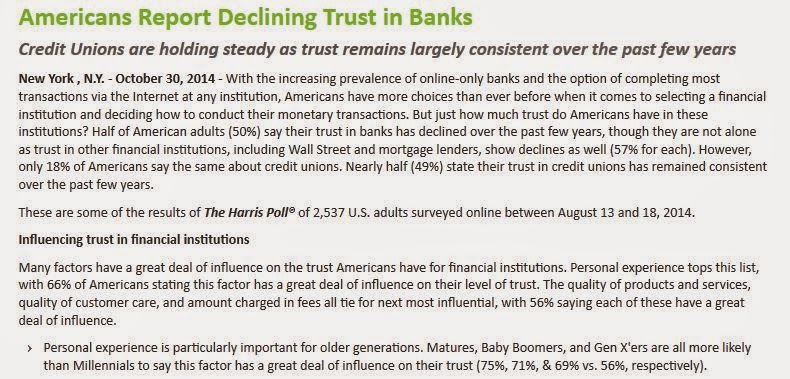
Another US study focusing on banks noted that online users are not all that influenced by social media when it comes to their increasing (and already pretty significant) distrust of banks. Instead users rely more on their personal experiences with banks - although Millennials and Gen X'ers are paying more attention than Baby Boomers to what is said about banks on social media.

http://www.harrisinteractive.com/NewsRoom/HarrisPolls/tabid/447/mid/1508/articleId/1515/ctl/ReadCustom%20Default/Default.aspx
Four USA-based social media events happened over the last week.
Qlik hosted a hackathon with the United Nations in Orlando, Florida.
Rise Up, a network activist forum hosted in Washington DC, successfully brought social media dissent into the Real World when Code Pink protestors disrupted a live interview between journalist Jorge Ramos and US Ambassador to the United Nations Samantha Power.  Ramos invited the protestors to explain their position onstage and Power responded.
The New York Social Technologies in Emergency Management (SoTechEM) project presented "Social Media Practices in Local Emergency Management: Results from Central New York.” 
Social media strategist for the city of Boston Lindsay Crudele, GovGirl Kristy Dalton, Social media strategist for the city of Las Vegas Jennifer Davies, and Derek Chan of the California Department of Motor Vehicles, co-hosted a webinar on what being a government social media manager involves.

Asia

In China, an article widely shared on social media stated "Dear teachers, because your profession demands something higher of you, and because of the solemnity and particularity of the university classroom, please do not speak this way about China!" The article warned teachers to lay off rhetoric that was overly critical of the State.

The Philippines Manpower Minister Muhammad Hanif Dhakiri, an avid Twitter user @hanifdhakiri, set the record straight after he was misquoted by an online news portal this week. Twitter followers of the minister blasted his account with criticism, and the Minister was quick to respond with an explanation.

Rappler, in partnership with the Australian Embassy in the Philippines and the Department of the Interior and Local Government (DILG) held an event this week to train local Philippine executives and disaster management personnel in the use of social media as a tool for disaster preparedness and response. The 2012 World Risk Report identified the Philippines, one of the world's most populous countries, as also one of the world's most disaster-prone.

One of the biggest trends on Twitter this week came out of India. The male Bollywood star, Farhan Akhtar, became UN Women's Goodwill Ambassador. Akhtar, @FarOutAkhtar on Twitter, launched the 2013 social initiative Men Against Rape and Discrimination (MARD) following the horrific gang rape of an Indian medical student on a bus that grabbed global headlines.

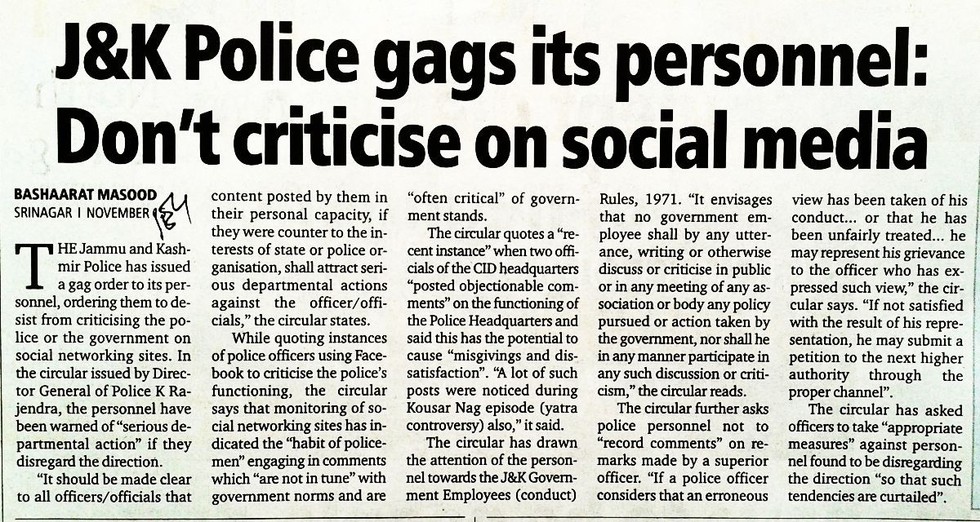
The Jammu and Kashmir Police in Northern India issued a gag order demanding that employees refrain from criticising the government or the police on social media. In Maharashtra, the government plans to strengthen social media labs of the regional police to combat cybercrime, in particular social media posts that look to incite local violence between different social groups.


In Bengaluru, where there have been nine cases of sexual abuse against schoolchildren, over 200 students came together to issue a Children's Charter on how to avoid future sexual abuse. In addition to asking parents to behave better, the Charter asks that children be banned from using social media and mobiles.


The Indian state of Gujarat hired social media experts to boost the region's brand.


Africa

Egyptian social media is abuzz after twenty-something  Egyptian Zainab El Mahdy hung herself allegedly citing her depression over Egypt's resistance to change following the 2011 revolution.
At Nigeria's 2014 Ogun State Nigeria Union of Journalists (NUJ) Press Week, Osun State Governor Aregbesola claimed social media was key in his victory and noted that social media needed to be “[E]xplored and protected for the betterment of our electoral process and political life but it should also be constitutionally made part of our electoral process.”
The Uganda Directorate of Information and National Guidance developed a set of social media guidelines for public servants. Government workers are not to post personal opinions on official accounts and are to identify themselves when discussing any topic in an official capacity on social media. The guidelines will be reviewed at a national Social Media Summit next week. 
Queen Rania of Jordan implored participants at the Abu Dhabi Media Summit this week to express the voice of the moderate Arab in social media. "We must create a new narrative and broadcast it to the world. If we don’t decide what our identity is and what our legacy will be, the extremists will do it for us."

Tools

Finally, worried your phone has been bugged by the government (as opposed to the NSA just harvesting your data via court orders issued to Google and Facebook?) Get Detekt, Amnesty International's new tool. Detekt scans your device for signs of spyware. 

Monday, April 6, 2015

Social media in government: 30 March to 5 April

On the 18th of April, the Earth Day Network along with Google, the World Bank, several pop stars and private corporate sponsors will host #GlobalCitizenEarthDay, a musical and entertainment event designed to "inspire citizens to take action to protect our planet and its people." The event will be held throughout Washington D.C.

The United Nations first ever Secretary-General's Envoy on Youth Ahmad Alhendawi (@AhmadAlhendawi) and the Sports and the English Premier League, among others, are commemorating the 20th Anniversary of the World Programme of Action For Youth with #YouthNow. #YouthNow is designed to encourage youth to participate in government and civil society and to share images and videos demonstrating their actions online.

North America

 Canada

As noted in an earlier edition of this blog, the British Columbia Civil Liberties Association (@bccla) obtained the Canadian Security Intelligence Service spring 2014 risk forecasts in which social media and citizen journalism were cited as elements of concern. Apparently these elements are also used by Government authorities to spy on the activities of protestors and activists. Documents show that between May 2014 and February 2015, Canada's central Government Operation Centre obtained reports on 160+ community events, protests, and demonstrations covering everything from protests for peace to rallies for Canadian veterans. Each of these events were followed and evaluated for potential risks and, to do so, officials tracked the social media activity of related groups and participants. The Centre was established in 2004 to provide "situational awareness" and continuous monitoring to government departments about potential or real hazards on a national scale. Critics claim the Centre has strayed from its mandate by spying on Canadian citizens exercising their civil rights. “It’s a really ridiculous way to go about doing something,” Michael Vonn, policy director at the B.C. Civil Liberties Association, protested. “The notion that there might be something that could happen, an eruption if you will ... in the context of any of these demonstrations, constitutionally-protected exercises of people’s rights, are so rare that the sense that we’re going to survey the landscape for the purpose is instantly suspect.”
The revelations are being used by activists to encourage Canadians to #RejectFear and stop the new anti-terror legislation, Bill C-51, which would give the Canadian Government broader powers when spying on Canadian citizens.
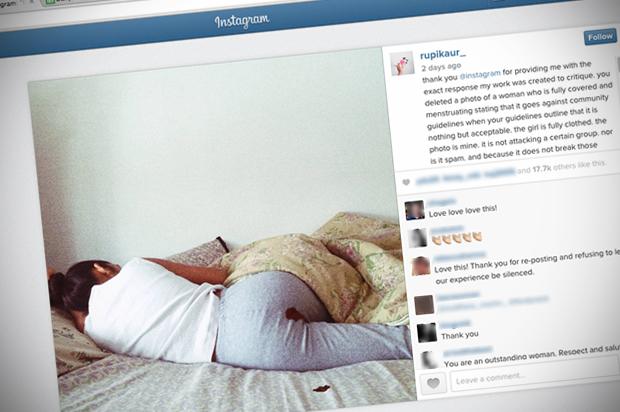
Rupi Kaur (@rupikaur_), a Sikh poet living in Canada, started a global online debate when she posted an Instagram photo of herself with a stain on her trousers from menstruation. Instagram deleted the photo, and Kaur took the opportunity to point out how sexy images of women in social networks are acceptable while images of women who are overweight or who experience average body functions are taboo. Instagram has since re-posted the photo along with an apology to Kaur.


Finally, a survey led by the Canadian province of Nova Scotia reported that social media efforts to tell local students about a government initiative to stop interest on student loans has been very successful.


USA

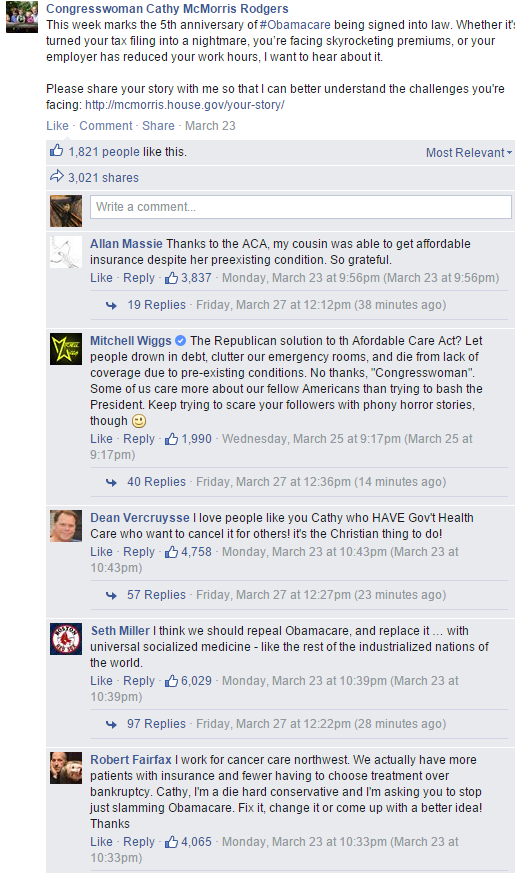
Due to the Affordable Care Act ("Obamacare"), estimates suggest that today an additional 16.4 million more Americans now have health insurance. Yet the Act remains the center of political controversy, and House Republican Chairwoman Cathy McMorris Rodgers asked Facebook users to share their "Obamacare horror stories" as they gear up for tax season. Ironically, she received a majority of responses sharing positive stories about the Act's new coverage.


In Indiana, the Governor is considering additional legislation to ensure that the "Religious Freedom" that he signed into law two weeks ago does not hurt Indiana business. After Governor Pence signed the bill into law, the hashtag #BoycottIndiana trended nation-wide. Users felt the law attempted to legitimize homophobia. Even Hilary Clinton joined in the debate last Monday on Twitter.
Arkansas is considering similar legislation, and the hashtag #BoycottArkansas is picking up speed in US social media.

South America

Mexico

Nicaragua

A social media campaign shut down an eight-year-old tradition in Managua's oldest mall and prompted the Nicaraguan Government to send a letter to the mall. The tradition was a swimsuit competition for girls ages 6 to 10 years old. Local activists from Quincho Barrilete Association felt the competition violated the "psychological and emotional integrity" of the girls involved. The Association ran a social media campaign that demanded the Nicaraguan Government condemn the competition. The Government did not expressly do so, but it did send a letter citing possible legal problems with the competition. The mall cancelled the event. 

Desde Asociación Quincho Barrilete hacemos el llamado al centro comercial Plaza Inter que retire los carteles donde...
Posted by Asociación Quincho Barrilete AQB on Thursday, March 26, 2015

Venezuela

The Financial Times explored how Venezuelans are using social media to find things they need - from toilet paper to powdered milk to updates on politics. Notice boards and forums allow citizens to barter for products not easily found in local stores, where inflation and shortages have made some basic necessities difficult to find. Via Twitter feeds, Venezuelans can locate medication that cannot be found in local pharmacies. According to Tendencias Digitales, one in three Venezuelans have a smart phone and at least one-sixth of the population has a Twitter account


Europe

In addition to anti-trust investigations into Google and Facebook data privacy issues, the European Union is now targeting Apple and Spotify and their streaming music plans. The EU sent questionnaires looking into the ecommerce practices to both companies. The investigation, not yet officially public, appears to be considering the fairness of online music ecommerce. 

United Kingdom

The UK Government has appointed Mike Bracken (@MTBracken) Chief Data Officer as well as Executive Director of Digital in the Cabinet Office, and head of the Government Digital Service.


Czech Republic

As noted in last week's post, U.S. troops visited the Czech Republic to demonstrate support for the NATO ally in the face of Russian aggression in Ukraine. At the same time, the visit aimed to feel out Czech support for NATO, given the country's historical ties to Russia. Czech social media was largely supportive of the visit, juxtaposing photos of the U.S. soldiers smiling with locals with more austere photos of the Moscow-led Warsaw Pact invasion of Czechoslovakia in 1968. However, there was still Czech social media criticising the visit.

Turkey

“A piece of advice: If chaos breaks out, find Fethullahçıs [a derogatory term used for members of the Gülen movement] first and wipe them out. It would be a bit difficult to find them, but you could start with the one who is the most sluggish and unreliable,” the pro-Government troll account @akkulis tweeted on Thursday. The account, notorious for harassing Turkish social media users that criticise the current Turkish Administration, was shut down last week after being spammed by other Twitter users as part of a social media war between pro and con Government netizens. The (in)famous (depending on your political views in Turkey) account of another pro-Government troll, Esat Ç., was also shut down but then quickly reopened another the alternative username @esatreis__. This account, also the target of Turkish as well as international spamming, was quickly suspended as well.

A few more pro-Government troll accounts referred to an incident in an Istanbul AK party (the ruling party) office in an attempt to incite conflict between the Alevis and the Sunnis, two different Islamic groups in Turkey. Under recent hate crime legislation in Turkey, the unknown individuals behind these accounts could get jail time.  At least one of these accounts, @YesilOperasyon, is still Tweeting. @YesilOPerasyon Tweeted, “Without their [Alevis] being wiped out totally, there will be no peace in the country.”

The members of an outlawed anti-Government group in Turkey, DHKP/C, took the prosecutor in a nationally infamous case hostage last Tuesday. The prosecutor and the gunmen died in a subsequent shoot-out, and images of the prosecutor with a gun to his head have been circulated on social media. Prime Minister Ahmet Davutoğlu has received the support of Turkish President Recep Tayyip Erdoğan for instituting a media ban against the media outlets that originally posted the image of the prosecutor. These media groups were not permitted to attend the prosecutor’s funeral. 

Russia

According to The Guardian, at the price of 750 US dollars per person per month, Russia's Kremlin employs trolls. The trolls are housed in an agency in Moscow where they churn out general Internet propaganda poking fun at Western leaders and promoting Putin. Each troll must generate 20 articles a day, and trolls are fined if they are caught copying and pasting text from old articles. “They painted a picture of a work environment that was humourless and draconian, with fines for being a few minutes late or not reaching the required number of posts each day. Trolls worked in rooms of about 20 people, each controlled by three editors, who would check posts and impose fines if they found the words had been cut and pasted, or were ideologically deviant.”


Africa

Both online and offline, Kenyans are mourning the victims of the country's deadly terror attack. Islamist militants from the group Al-Shabaab attacked Garissa University College in Kenya on April 2nd, killing students and administrators as they moved through the campus. The attack killed 147 individuals, and the hashtag #147notjustanumber has been used to share images of and stories about the victims in happier times.


Middle East

Tunisia

Since the attack on tourists and Tunisians in the museum in Bardo earlier this month, global social media has joined in the trending hashtag #IWillComeToTunisia and #JesuisBardo. The income of an estimated one in every five Tunisians depends on tourism, and the hashtag is meant to promote Tunisia with tourists who might reconsider visiting the country after the Bardo terrorist attack.


Syria

The Syrian branch of al Quaeda led by al-Nusra Front took the provincial capital Idlib in Syria on the 29th of March.  Hours before the official confirmation of the city's capture by Syrian authorities, the group Tweeted its victory, "The city of Idlib has been liberated and the mujahideen have chased out the last chabbihas (militias loyal to Assad), who have fled."

ISIS fighters have also taken control of most of the largely Palestinian refugee camp Yarmouk in Southern Damascus. Social media circulated the beheadings of two Palestinian fighters from the camp.

The United Arab Emirates

In the UAE last week, the Government of Dubai Media Office organised a workshop for media and corporate relations officers on the ideal use of social media. Facebook’s Politics and Government Specialist in Europe, the Middle East & Africa Elizabeth Linder joined Instagram's Political Outreach Associate Manager in Europe, the Middle East & Africa John Tass-Parker in lecturing Dubai officials on how to use social media to communicate professionally with the public. Linder and Tass-Parker pointed to the rising number of visitors and overall engagement with Dubai Government social media highlighting the following statistics:


A photo posted by John Tass-Parker (@johntassparker) on
At the Future Cities Forum, Dubai 2015, the American business magnate, politician, and philanthropist Michael Bloomberg suggested that social media has perhaps too drastically reduced the time between which a politician takes office and when his work is reviewed. "Social media is a two-way medium and you can’t always differentiate between who said what making it much more difficult to run a company or a country. Social media has changed the world — it is no longer the powers that control what is said...Social media will end up censoring content...”

Bahrain

Bahrain hosted the Bahrain International e-Government Forum 2015 last week. Workshops focused on social media, building innovation into government services, user experience, big data, project management, and more.

في اليوم الأخير من فعاليات منتدى #البحرين الدولي للحكومة الإلكترونية 2015 .. وزير الدولة لشئون المتابعة في لقاء مع قيادا...
Posted by bahrain.bh on Friday, March 20, 2015

Yemen

In Yemen, fighting continues and amidst the confusion in the city of Mukalla, the capital of the central province of Hadramawt, 300 inmates escaped from jail. One, Khalid Bartafi, a well-known member of the al-Qaeda branch in Yemen, had the time to snap and post selfies of himself exploring lavishly decorated government buildings. Bartafi snapped seflies of himself laying on expensive sofas in the governor's palace and standing on the Yemen flag.


Asia

Nepal

In Nepal, Doctor Govinda KC has been fasting for several days. He fasts to protest corruption in the Nepalese medical training system, which, according to Dr. KC and others, has allowed politics to water down the quality of medical care in the country. The social media hashtag #IamwithDrKC has gained growing support in social media and among medical practitioners. The hashtag was shared over 8 thousand times last week alone and a corresponding Facebook page, Solidarity with Prof Dr Govinda KC, has over 10 thousand likes.


India

In early March the Indian state of Maharashtra, home to India's financial capital Mumbai, passed a five-year jail sentence and a fine of 10,000 rupee ($162) for the sale or possession of beef. The hashtag #beefban has been growing on Indian social media ever since as netizens weigh in on the legislation. India is 80% Hindu, and the current nationalist Modi Government is led by a man who championed a beef ban in his own state of Gujarat. Last week the federal interior minister Rajnath Singh told religious leaders at a gathering that India will use its "might" to ban the slaughter of cows throughout India. This prompted renewed interest in the #beefban.
BJP party president Amit Shah will hold a meeting of BJP social media leaders next week to discuss how to regain momentum. BJP social media generated much positive buzz for current leader Modi during the last election. However, since Modi was elected, the social media wing of the party's outreach has lost focus, reportedly due to a lack of leadership and direction.

At the same time the party reviews its promotion, in honour of the current BJP Government's first year anniversary, the the New Media Cell of the Information & Broadcasting Ministry in consultation with the Prime Minister's Office have prepared 60 slides that supporters are releasing throughout social media. Slides sport images of the Prime Minister in various poses along with text describing how the current NDA Administration has "spellbound investors," made women feel "safer," and sped up construction, among other reported accomplishments. The goal of the campaign is to make the current Government appear more successful than the former UPA Government. Reactions so far have been mixed - from support to sarcasm (#Modisarkar).
In an example of collaborative policy-making, the railway system in the city of Chennai began a "local circle" (an online social network) called Emergency Readiness in Chennai. Over four thousand people have joined the circle since it opened on March 21st. The initiative described its aim as follows: "train accidents, natural or other disasters/emergencies in your city, this community will enable real time information broadcast and exchange thereby facilitating faster response/assistance from the local community and administration."

China

GreatFire.org, an organisation dedicated to helping Chinese citizens get around the so-called "Great Firewall" of China, and CN-NYTimes, a site that mirrors the content of the New York Times in Chinese, suffered from Distributed Denial of Service (DDoS) attacks. The attacks began 17 March and continued for several days. Each time the host of the sites, Github, changed its defences, the attackers did as well. “Very clearly, the Cyberspace Administration of China is behind both of the recent DDoS attacks,” Charlie Smith, co-founder of GreatFire.org, wrote in GreatFire's blog. “Hijacking the computers of millions of innocent internet users around the world is particularly striking as it illustrates the utter disregard the Chinese authorities have for international as well as even Chinese internet governance norms...The Great Firewall has switched from being a passive, inbound filter to being an active and aggressive outbound one...An earlier report about an unrelated GFW upgrade stated that 'Every machine in China has the potential be a part of a massive DDOS attack on innocent sites,' and “They have weaponized their entire population.” That was too optimistic. Now CAC has weaponized the entire Internet population.”  The CAC or an affiliate used Baidu, China's search engine (akin to Google in the West), to create the DDoS. 


Gary Pruitt, chief executive and president of The Associated Press, visited China's state-run Xinhua news agency March 27th. Pruitt toured the social media operations centre and posed for photos with Xinhua president Cai Mingzhao. Xinhua then published a story explaining that "the world's two leading news agencies [The AP and Xinhua] have agreed to strengthen co-operation in social media". The story generated a lot of buzz, including from The Associated Press, which protested that Xinhua's claim was fabricated. Ironically, during the visit, Pruitt had delivered the following statement in Hong Kong when calling for violence against journalists to be made a war crime: "Extremist organisations don't need us to get their story out - they can use social media and other means and they certainly don't want an independent media to observe them. They want to control their message from start to finish."

Chinese taxi drivers from Suifenhe attempted to commit suicide in the middle of a public shopping street in Beijing last Tuesday. The drivers were part of a number of online and offline Chinese protesting the allegedly corrupt government monopoly of taxi operators. Taxi operators can arbitrarily determine the licensing fees that taxi drivers have to pay, legislate which sort of car Chinese taxi drivers need to have, etc. As a result, many Chinese taxi drivers struggle to make ends meet. No one died as a result of the protest, according to reports, but the event did attract a lot of sympathy (and then censors) on Chinese social media.


Malaysia

Datuk Shamsul Anuar Nasarah, a Government backbencher in the Malay House or Representatives, called for the Malaysian Communication and Multimedia Commission (MCMC) to receive more power to control social media abuse. His demand came as a result of a story from the Malaysian Insider that alleged the Malay Conference of Rulers were against the implementation of hudud law in a Malaysian state. Three editors and two executives of The Malaysian Insider news portal were charged with sedition following the story's publication. "The action by the Malaysian Insider, in using unconfirmed reports [from social media], (is) seen like belittling the royal institution is extreme and cannot be allowed because of the fear that it can make the people to feel unsafe as the highest institution is not protected," Anuar Nasarah argued.

Current Malay Home Minister Datuk Seri Dr Ahmad Zahid Hamidi said that the Malaysian Communications and Multimedia Commission (MCMC) should block all ISIS video recordings of on social media to prevent youths and women in the country from being influenced by ISIS retrogressive ideology. The Government's move to block certain radical websites in the last few months has sparked some discussion about the best way to dissuade Malaysians from considering ISIS propaganda.

The former Malay Prime Minister Tun Dr Mahathir Mohamad used his personal blog chedet.cc to criticise the current Prime Minister Datuk Seri Najib Razak. Dr Mahathir pointed to two scandals that occurred under Najib's Administration and suggested the Malay people no longer trusted Najib. The post has since gone viral. This and other social media prompted the Communication and Multimedia Ministry’s Department of Special Affairs (Jasa) Director-General Datuk Mohd Puad Zarkashi to tell reporters, “We know Tun M’s latest posting has gone viral and it is becoming too negative. Jasa will take the bull by the horns in this matter and go on ‘attack’ mode (via social media)....Governments have lost in elections before due to social media. This has happened in other countries. So, we do not want social media to be continuously used to criticise the current government.” In general, the Director-General encouraged the Malay civil service to curb anti-government social media with positive posts and stories.


The Prime Minister's Principal Secretary Rompin MP Tan Sri Jamaluddin Jarjis and five others died in a helicopter crash at the end of the week, and Malaysians used social media to express their condolences to the families of the victims.

Australia

In Australia, homeless people are turning more and more to social media and crowdfunding services to support their needs. "Social media is being used by more and more people to find solutions and address needs, from raising money to pursue creative projects, to finding a flatmate," Sarah Toohey, policy and communications manager at the Council to Homeless Persons told The Age reporter Alana Schetzer (@schetzer). "It's unsurprising that people in crisis are using social media to address their immediate needs, such as finding cheap housing or seeking donations to help get them out of debt." Seventy-seven percent of homeless people in Sydney and Melbourne have smart phones (95% have phones.) Infoxchange, an app to help those that are homeless or who are at risk to become homeless, won the Google Impact Challenge. Infoxchange seeks to streamline the access of homeless people to existing services and support.


Papua New Guinea

Papua New Guinea (PNG)'s National Information and Communication Technology Authority (NICTA) put forward a cybercrime policy proposal to PNG's National Executive Council for deliberation last week. If the policy is approved, PNG's Parliament will vote on whether or not to make the policy law. The policy includes rules to curb social media abuse. The rules demand that those using social media to criticise public officials be required to use their real names rather than pseudonyms. “It is not our intent to control the media but there must be some proper mechanisms in place … people have to be responsible when they are using social media to attack others. For cyber-crime, we are going to make it an offence for people to use pen-names, not using their real names and making defamatory statements. You have to be answerable for it,” NICTA Chief Executive officer Charles Punaha said recently.


For more, some reports and tools to consider this week. 

Reports

Using Baidu to steer millions of computers to launch denial of service attacks or How the Great Fire Anti Censorship Project and Amazon's Cloud Front are under Denial of Service attack. GreatFire.org published this report after they experienced a DDoS attack the 17th of March. The attack lasted several days which gave the organisation time to put together a report, a blog post and several social media posts (in English and Chinese) about the dangers of the Chinese Government using millions of unsuspecting Internet users to launch an attack against private Internet sites. 

Corrupting the Cyber-Commons: Social Media as a Tool of Autocratic Stability by University of Toronto political scientist Seva Gunitsky

Gunitsky lays out four mechanisms that link social media co-optation to autocratic resilience: 
  1. counter-mobilization 
  2. discourse framing 
  3. preference divulgence 
  4. elite coordination
He describes the use of these tactics in mixed and autocratic regimes, focussing on Russia, China, and the Middle East.

Digital Trends Report | Informe de Tendencias Digitales 2015: Toma el control de tus contenidos is a Spanish-language report looking at trends in digital marketing and communication. The report is the sixth annual look at trends by Tendencias Digitales and covers:

  • unified digital experiences (Arial is still the most popular font)
  • adaption of content to each screen size (wearable technology is here to stay...and grow)
  • content for the car
  • more personalised and geolocalised content
  • e-health (it's the new black)
  • privacy protection in the cloud
  • technology for the technophobes
  • the intersection between fashion and technology
  • Politics 2.0 and "click-activism" 

Tools

Popvox

Popvox uses real-time legislative data mixed with individual input. Information is shared with government officials that - most importantly - take citizen feedback seriously.

Grade.DC.Gov

According to the website, "this program enables you to submit comments about certain District agencies and view how District residents graded those agencies. The goal is to help you better engage with your government and help government agencies to improve the quality of their services."